Takata Airbag Recall: The Ultimate 2024–2026 Affected Vehicles List & Safety Guide
2024–2026 Affected Vehicles List & Safety Guide

Introduction
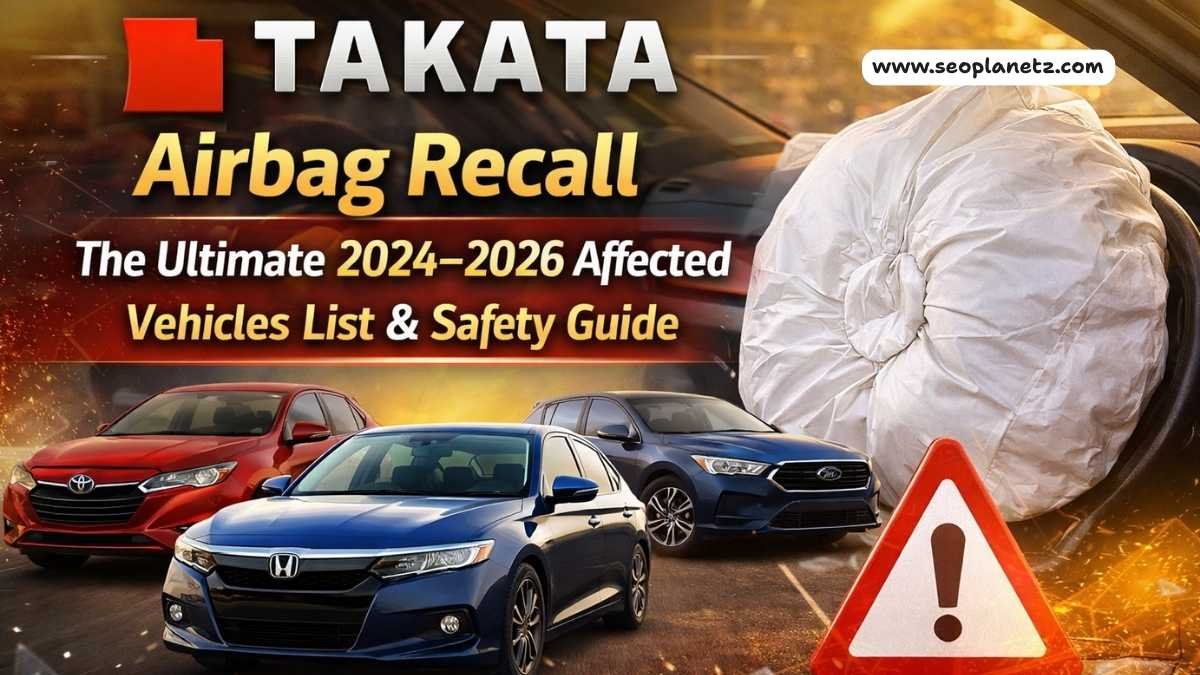
The Takata airbag recall is not a story from the past — it is an ongoing, active safety crisis that continues to claim lives in 2024, 2025, and 2026. Vehicles made by 19 different automakers across 34 brands have been recalled to replace frontal airbags — in what NHTSA has called “the largest and most complex safety recall in U.S. history.” The numbers are staggering: the recall has claimed at least 58 lives in the United States alone, injured more than 2,023 people, and affected over 100 million vehicles across 17+ manufacturers.
What makes this recall particularly alarming is that new waves of recalls and “Do Not Drive” warnings continue to be issued years after the original crisis began. On October 31, 2025, BMW issued yet another Takata airbag recall — twelve years after the first recalls began, this crisis is still active.
According to the NHTSA Takata Recall Spotlight, this remains the most dangerous open automotive safety issue in American history. If you drive a vehicle manufactured between 2000 and 2018, you need to read this guide — then check your VIN immediately.
What Is the Takata Airbag Defect and Why Is It Deadly?
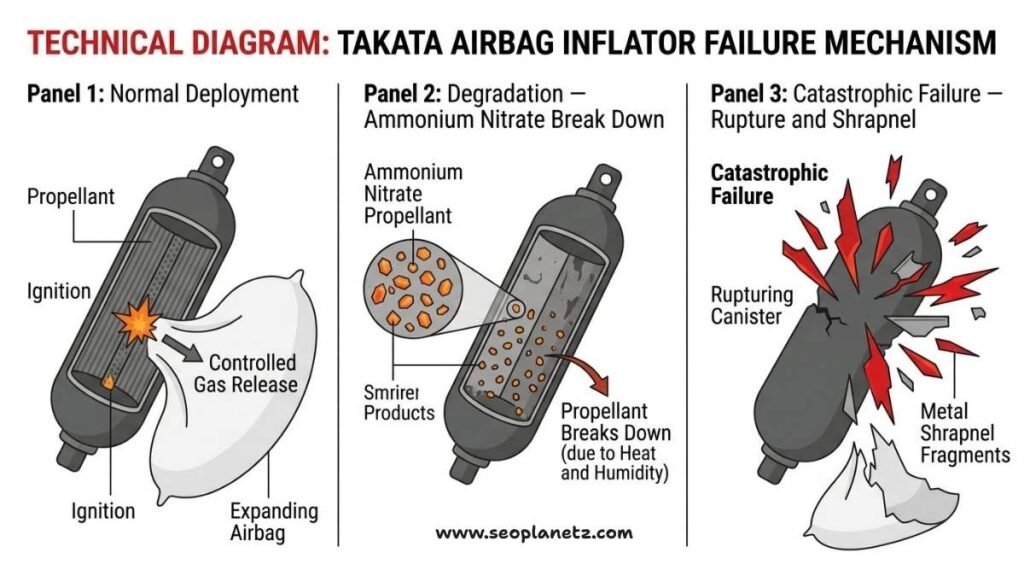
Understanding the defect is the first step to understanding the urgency. Takata used ammonium nitrate as a propellant in their airbag inflators. This chemical degrades over time, especially in heat and humidity.
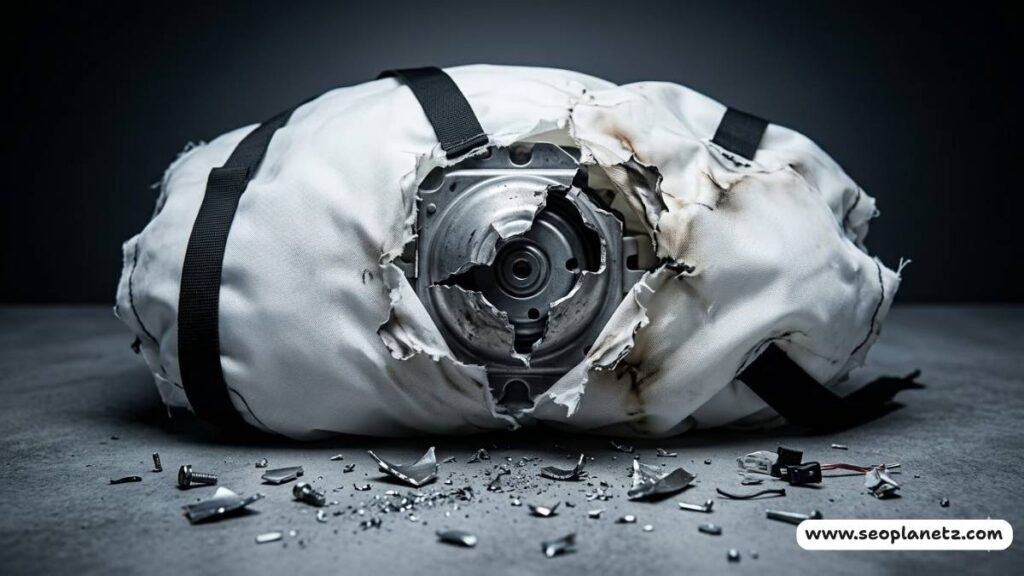
When a crash occurs and the airbag deploys, the degraded propellant can explode with excessive force. The metal inflator canister ruptures, shooting sharp metal fragments at high velocity into the vehicle cabin — turning a life-saving safety device into a potentially lethal one.
At the heart of the problem is the airbag’s inflator — a metal cartridge loaded with propellant wafers — which in some cases has ignited with explosive force. If the inflator housing ruptures in a crash, metal shards from the airbag can be sprayed throughout the passenger cabin. As explained in detail by Consumer Reports’ complete Takata airbag guide, the risk is not uniform — high heat and high humidity dramatically accelerate the chemical degradation process. This is why vehicles in hot, humid states like Florida, Texas, and Hawaii carry an elevated risk profile.
Also Read: Car Fuel Pump Price and Maintenance in 2026
The Real-World Human Cost
These are not hypothetical statistics. A husband driving a 2008 Honda Accord with his daughter was struck head-on by a drunk driver. The impact was severe, but witnesses expected survivors. Instead, the driver died — investigators found large pieces of plastic lodged throughout the vehicle. The family never received a recall notice until they checked years later — just days after the accident, the first Takata recalls were announced.
A son driving a 2014 Jeep Patriot hit a tree. He was wearing his seatbelt and had no bodily injuries except a scratch on his leg. But the side airbag deployed, and a sharp metal object severed his artery. The device meant to protect him killed him.
These cases represent a fraction of the real toll. Honda alone has reported 17 deaths and more than 200 injuries in the United States related to Takata inflators. Every unrepaired vehicle on the road is a risk that does not need to exist. The full scope of documented cases is maintained by NHTSA’s safety defects database for public reference.
The Scale of the Recall: Key Statistics
A total of 67 million airbags have been recalled in the United States. As of 2024, NHTSA reports that 88 percent have been repaired or replaced — still leaving many millions of at-risk airbags on the road. Just over 5 million vehicles in the US still have unrepaired Takata airbags, according to Carfax data tracked via the Carfax Recall Tracker.
This is three to four times larger than the previous largest recall in automotive history — the GM ignition switch recall, which affected about 30 million vehicles. The Takata crisis affects virtually every major automaker and spans more than 15 model years. NHTSA states that recall work must be done for free by the automaker for at least 15 years after the recall is issued. Since the first Takata recalls were issued in 2014, all affected vehicles are covered until at least 2029.
| Statistic | Figure |
|---|---|
| Total airbags recalled (global) | 100+ million |
| US airbags recalled | 67 million |
| Vehicles affected (US) | 40+ million |
| Deaths confirmed (US) | 58+ |
| Injuries confirmed (US) | 2,023+ |
| Automakers involved | 19 manufacturers / 34 brands |
| Vehicles still unrepaired (US) | ~5 million (2026 estimate) |
| Repair cost to vehicle owner | $0 — 100% FREE |
| Repair coverage deadline | At least through 2029 |
2024–2026 Takata Recall Updates: What’s New
The Takata airbag recall has not gone quiet. Below are the most significant developments from 2024 through early 2026.
January 2024 — Toyota and GM Issue New Recall
In January 2024, Toyota and General Motors issued a recall of 61,000 of their older Corolla, Matrix, RAV4, and Pontiac Vibe model vehicles sold in the United States that carry the Takata airbag. This recall affected 50,000 Toyota and 11,000 General Motors vehicles.
January 2024 — Toyota “Do Not Drive” Warning
Toyota issued a “Do Not Drive” warning for about 50,000 vehicles, including 2003–2004 Corolla and 2003–2004 Corolla Matrix. These vehicles were flagged as carrying the highest explosion risk profile due to age, heat exposure, and unrepaired status. Full details are available on the Toyota USA Recall Page.
Also Read: 2026 Toyota Prius Review, Price, and Specs
May 2024 — Nissan and Infiniti “Do Not Drive” Warning
A “Do Not Drive” warning was issued for the 2002–2006 Nissan Sentra, 2002–2004 Nissan Pathfinder, and 2002–2003 Infiniti QX4. NHTSA confirmed that 83,920 of these vehicles remain on the road with dangerous unrepaired airbags. Nissan owners can verify their vehicle status at the Nissan Recall Center.
Also Read: The Ultimate 2025 Nissan Maxima Specs, Prices, and Performance Guide
July 2024 — BMW Recalls 390,000+ Vehicles
BMW recalled more than 390,000 3 Series sedans and wagons due to a faulty Takata airbag inflator installed in the steering wheel, covering model years 2006–2011 for sedans and 2006–2012 for Sportswagons. BMW owners can check their status at the BMW Recall & Updates Page.
August 2024 — Ford Issues “Do Not Drive” Warning
Ford issued a warning that owners of certain vehicles made between 2004 and 2014 should not drive until they check whether their car, truck, or SUV needs its Takata airbags replaced. The vehicles include:
- 2004–2011 Ford Ranger
- 2005–2014 Ford Mustang
- 2006–2012 Ford Fusion, Mercury Milan, Lincoln MKZ, and Lincoln Zephyr
- 2007–2010 Ford Edge and Lincoln MKX
Ford owners can verify open recalls using the Ford Recall VIN Check Tool.
November 2024 — Volkswagen Recalls 123,000 Vehicles
Volkswagen recalled more than 123,000 vehicles including the 2017–2019 Beetle, 2012–2014 Passat, and 2006–2007 Passat Sedan due to the driver’s side frontal airbag inflator, which could explode during deployment. Volkswagen dealers replace the faulty airbag modules at no cost.
Also Read: Stunning 2025 Volkswagen Sedan: New Design & Features That Impress
October 2025 — BMW Issues Yet Another Recall
BMW issued another Takata-related recall in October 2025, confirming that additional vehicles from its model range required immediate inflator replacement — twelve years after the first Takata recalls began.
2025 — Citroën European Recall
In 2025, Citroën recalled almost 900,000 cars in Europe affecting the C3 from 2009 to 2019 and the DS3 from the same years. Stellantis subsequently upgraded the recall and urged owners not to drive the car until the airbag issue was resolved. European owners can check status through the European Commission vehicle safety recall database.
Affected Vehicles by Manufacturer: The Complete List
The following is a comprehensive breakdown of makes and models confirmed as part of the Takata recall. The airbags were installed in cars mostly from model years 2002 through 2015. Always verify your specific VIN at the NHTSA official recall lookup tool for the most current status.
Acura
- 2003–2007 Acura MDX
- 2005–2012 Acura RL
- 2007–2012 Acura RDX
- 2002–2003 Acura TL
- 2002–2003 Acura CL
- 2013 Acura ILX, TL, TSX, ZDX, RDX, MDX
BMW
- 2000–2013 BMW 3 Series (multiple body styles including M3)
- 2001–2003 BMW 5 Series (including M5)
- 2008–2013 BMW 1 Series
- 2007–2010 BMW X3
- 2001–2003 / 2007–2013 BMW X5
- 2008–2014 BMW X6
- 2013–2015 BMW X1
Chrysler / Dodge / Jeep / Ram
- 2003–2008 Chrysler PT Cruiser
- 2004–2011 Dodge Dakota
- 2006–2011 Dodge Raider
- 2014 Jeep Patriot
- Multiple Ram pickup truck configurations
Ford / Lincoln / Mercury
- 2004–2011 Ford Ranger
- 2005–2014 Ford Mustang
- 2006–2012 Ford Fusion
- 2007–2010 Ford Edge
- 2006–2012 Mercury Milan
- 2006–2012 Lincoln MKZ / Lincoln Zephyr
- 2007–2010 Lincoln MKX
General Motors (Chevrolet / GMC / Cadillac / Pontiac)
- 2007–2013 Chevrolet Silverado 1500
- 2007–2014 Chevrolet Silverado 2500/3500 HD
- 2007–2013 Chevrolet Avalanche
- 2007–2014 Chevrolet Tahoe
- 2007–2014 Chevrolet Suburban
- 2003–2004 Pontiac Vibe (DO NOT DRIVE)
- Multiple Saab 9-2X, 9-3, 9-5 models
Honda
- 2001–2003 Honda Accord (DO NOT DRIVE)
- 2001–2003 Honda Civic
- 2001–2003 Honda CR-V
- 2001–2003 Honda Odyssey
- 2001–2003 Honda Pilot
- 2003–2011 Honda Element
- 2006–2014 Honda Ridgeline
- 2003–2013 Honda Fit
- Multiple additional model years across the entire Honda lineup
Nissan / Infiniti
- 2002–2006 Nissan Sentra (DO NOT DRIVE)
- 2002–2004 Nissan Pathfinder (DO NOT DRIVE)
- 2001–2004 Nissan Frontier
- 2001–2004 Nissan Xterra
- 2002–2003 Infiniti QX4 (DO NOT DRIVE)
- Multiple Infiniti FX, G, and M series models
Toyota
- 2003–2004 Toyota Corolla (DO NOT DRIVE)
- 2003–2004 Toyota Corolla Matrix (DO NOT DRIVE)
- 2002–2007 Toyota Camry
- 2002–2005 Toyota RAV4
- 2003–2006 Toyota Tundra
- 2003–2006 Toyota Tacoma
- 2003–2006 Toyota Sequoia
- 2004–2005 Toyota 4Runner
- 2002–2007 Lexus SC models
Volkswagen
- 2017–2019 Volkswagen Beetle
- 2012–2014 Volkswagen Passat
- 2006–2007 Volkswagen Passat Sedan
Other Manufacturers
- Multiple Mazda models (2003–2012 Mazda6, 2006–2007 Mazdaspeed6, 2003–2008 Mazda RX-8)
- Multiple Subaru models (2003–2014 Legacy, 2003–2014 Outback, 2003–2007 Forester)
- Multiple Mitsubishi models
- Multiple Audi models
- Multiple Ferrari models
- Jaguar / Land Rover models
- Multiple Saab models
“Do Not Drive” Warnings: The Highest Risk Vehicles
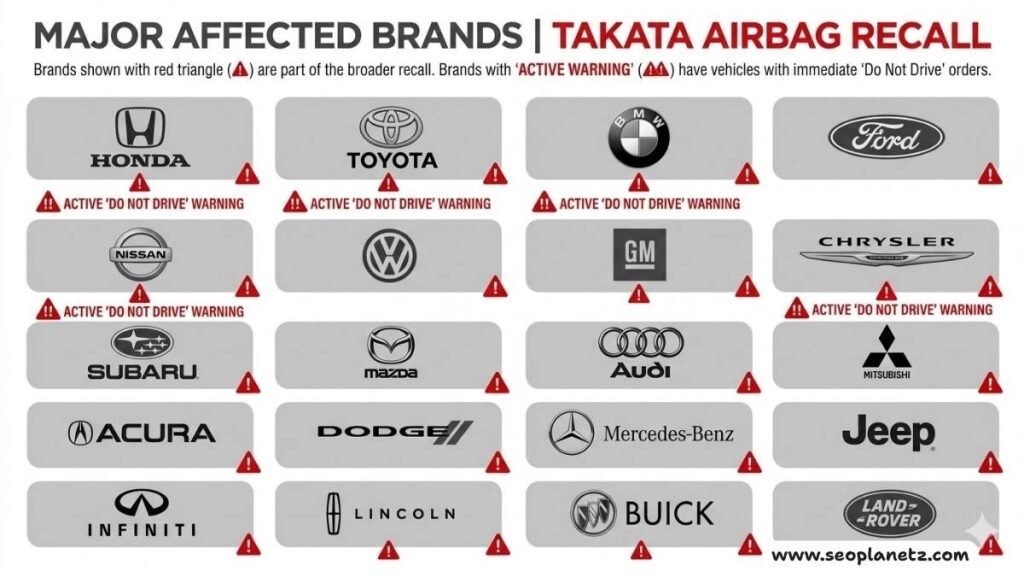
“Do Not Drive” warnings have been issued for certain vehicles that are at a far higher risk for an airbag explosion that could injure or kill vehicle occupants. These vehicles should be repaired immediately. The full and current list of active “Do Not Drive” designations is maintained on the NHTSA Do Not Drive Warning page.
If you own any of the following vehicles and the recall has not been repaired, stop driving it immediately and contact your dealer for a free repair or free loaner vehicle:
| Make | Model | Years | Warning Status |
|---|---|---|---|
| Honda | Accord, Civic, CR-V, Odyssey, Pilot | 2001–2003 | DO NOT DRIVE |
| Acura | TL, CL | 2002–2003 | DO NOT DRIVE |
| Toyota | Corolla, Corolla Matrix | 2003–2004 | DO NOT DRIVE |
| Nissan | Sentra | 2002–2006 | DO NOT DRIVE |
| Nissan | Pathfinder | 2002–2004 | DO NOT DRIVE |
| Infiniti | QX4 | 2002–2003 | DO NOT DRIVE |
| Pontiac | Vibe | 2003–2004 | DO NOT DRIVE |
| BMW | 3 Series, 5 Series, X5 (older) | 2000–2006 | DO NOT DRIVE |
| Ford | Ranger | 2004–2011 | DO NOT DRIVE (check VIN) |
| Ford | Mustang | 2005–2014 | DO NOT DRIVE (check VIN) |
Every recall repair is free — contact your dealer as soon as possible to get the recall repair at no charge.
How to Check if Your Vehicle Is Affected
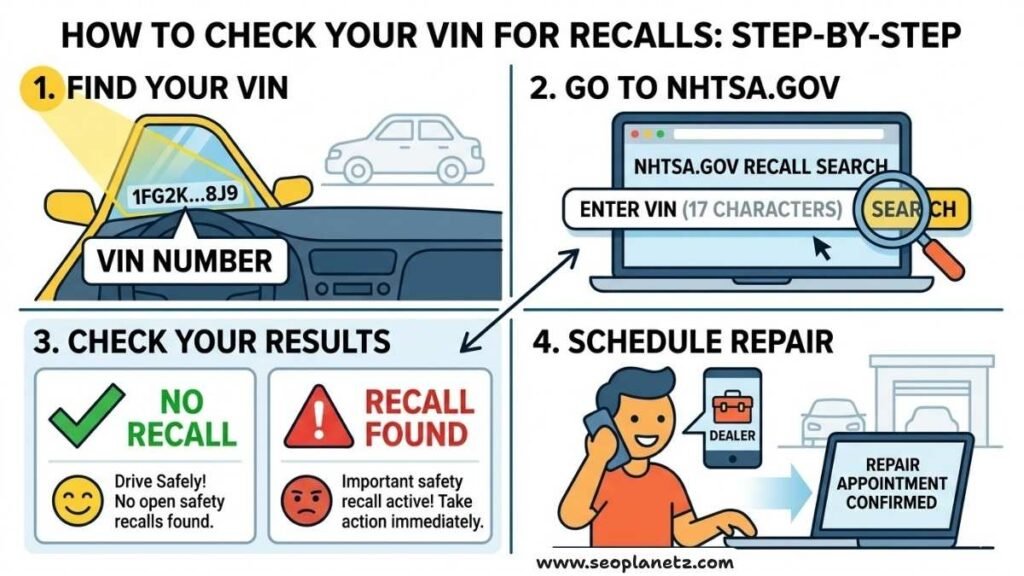
Checking your vehicle takes less than two minutes and could save your life.
Step 1 — Find Your VIN Your 17-character Vehicle Identification Number is located on the driver’s side dashboard (visible through the windshield), on the driver’s door jamb sticker, or on your vehicle registration and insurance documents.
Step 2 — Visit the NHTSA Recall Lookup Tool Go to the NHTSA official VIN recall lookup tool and enter your VIN. The system displays all open recalls — including Takata — associated with your specific vehicle.
Step 3 — Check with Your Manufacturer Most manufacturers also operate their own recall lookup tools. Honda, Toyota, BMW, Ford, GM, Nissan, and Volkswagen all have dedicated VIN checkers on their official websites linked throughout this article.
Step 4 — Contact Your Dealer If your vehicle has an open Takata recall, call your local authorized dealer immediately. If you haven’t received a notice by mail, use the NHTSA lookup tool to verify your status.
Step 5 — Set Up Recall Alerts Sign up for email alerts at NHTSA Recall Alerts to receive automatic notifications for any future recalls affecting your vehicle. NHTSA recommends checking the VIN lookup tool at least twice a year.
What Happens During the Free Recall Repair?
The repair involves replacing the defective Takata airbag inflator — the metal cartridge inside your airbag module — with a new, safe replacement unit. In some cases, the entire airbag module is replaced. The repair typically takes one to four hours depending on whether the replacement is on the driver’s side, passenger’s side, or both.
All costs are covered 100% by the manufacturer — parts and labor. General Motors covers the entire cost of the recall repair and even offers authorized mobile repair units that can come directly to your home or work. Honda, Toyota, BMW, and other manufacturers offer free loaner vehicles or alternate transportation for the duration of the repair.
NHTSA confirms that recall work must be done for free by the automaker for at least 15 years after the recall is issued. Since the first Takata recalls were issued in 2014, all affected vehicles are covered until at least 2029. For a complete breakdown of your legal rights as a vehicle owner in a recall situation, the FTC’s guide on vehicle recalls and consumer rights is an authoritative resource.
Key Takeaways
Here is a summary of the most critical facts about the Takata airbag recall:
- The Takata airbag recall is the largest automotive recall in US history — affecting over 40 million US vehicles across 34 brands from 19 manufacturers
- The defect is caused by ammonium nitrate propellant degrading due to heat, humidity, and age — turning the airbag into a metal shrapnel device
- At least 58 Americans have died and over 2,000 have been injured — and new recalls continue to be issued as recently as October 2025
- “Do Not Drive” warnings are active for specific Honda, Toyota, Nissan, Infiniti, Ford, BMW, and Pontiac models — stop driving these vehicles immediately if unrepaired
- 5 million US vehicles still have unrepaired Takata airbags as of early 2026
- The repair is completely free — manufacturers are legally required to fix affected vehicles at no charge until at least 2029
- Check your VIN immediately at the NHTSA official recall lookup tool — it takes less than two minutes
Frequently Asked Questions
Q: Is the Takata airbag recall still active in 2026?
A: Yes — the Takata airbag recall remains fully active in 2026. New recalls and “Do Not Drive” warnings were issued as recently as October 2025 by BMW, and approximately 5 million US vehicles still have unrepaired Takata airbags. This crisis is ongoing. If you haven’t checked your vehicle recently, do it today at the NHTSA Takata Recall Spotlight.
Q: How do I know if my car has a Takata airbag recall?
A: The fastest way is to visit the NHTSA official recall lookup tool and enter your 17-character VIN number. The tool is free, takes under two minutes, and shows all open recalls for your specific vehicle. You can also sign up for NHTSA recall email alerts to be notified of future recalls automatically.
Q: Is the Takata airbag recall repair really free?
A: Yes — 100% free, with no exceptions. Under US federal law, manufacturers must repair all recalled vehicles at no charge to the owner for at least 15 years after the recall is issued. Since the first Takata recalls were issued in 2014, free repairs remain available until at least 2029. Parts, labor, and in many cases a loaner vehicle, are all provided at zero cost.
Q: Which cars have the most dangerous Takata airbags?
A: Vehicles under “Do Not Drive” warnings carry the highest risk — including 2001–2003 Honda Accord, Civic, CR-V, Odyssey, and Pilot; 2003–2004 Toyota Corolla and Corolla Matrix; 2002–2006 Nissan Sentra; 2002–2004 Nissan Pathfinder; 2002–2003 Infiniti QX4; and certain older BMW models. The full current list is on the NHTSA Do Not Drive Warning page.
Q: Can a Takata airbag explode without being in a crash?
A: No — the airbag inflator only activates during a crash event that triggers the deployment sensor. However, during any crash that deploys the airbag, the degraded inflator can rupture explosively — even in minor collisions that would otherwise be non-fatal. This is precisely what makes the defect so dangerous. Minor fender-benders have killed drivers whose airbags should have protected them.
Q: What if I bought a used car and it has an open Takata recall?
A: You are still entitled to the free recall repair regardless of whether you are the original owner. Recall repairs are tied to the vehicle, not the buyer. Take the car to any authorized dealer of that brand and they are legally required to fix it at no charge. For more details on your consumer rights, visit the FTC’s vehicle recalls consumer guide.
Q: How long does the Takata airbag recall repair take?
A: Most Takata airbag recall repairs take between one and four hours at an authorized dealership, depending on whether the driver’s side, passenger’s side, or both modules need replacement. Dealers provide free loaner vehicles in most cases. Call your dealer in advance to confirm parts availability for your specific model before your appointment.

Conclusion
The Takata airbag recall is the deadliest automotive safety crisis in American history — and it is not over. With 5 million vehicles still carrying unrepaired defective airbags as of 2026, and new “Do Not Drive” warnings continuing to be issued from manufacturers including BMW as recently as 2025, this is not a resolved story.
The solution is simple, free, and available right now. Every affected vehicle owner has the legal right to a 100% free repair at any authorized dealership — no cost, no hassle, and in many cases with a free loaner car while your vehicle is being serviced. The repair remains available through at least 2029.
Take two minutes today. Enter your VIN at the NHTSA official recall lookup tool. If your vehicle has an open Takata recall, call your dealer today. If you’ve received a “Do Not Drive” warning, stop driving the vehicle immediately and arrange free alternate transportation through your manufacturer.
No recall repair is worth delaying. Check your VIN — it may be the most important two minutes you spend this year.